

Featured News - Current News - Archived News - News Categories
Why MIPS® Hard Hats Could Be the Future of Worker Safety
by mdsassociatesWhy MIPS® Hard Hats Could Be the Future of Worker Safety
At MDS Associates, safety has always been our top priority. For almost four decades, we have supplied hardworking teams with the protective equipment they rely on every day. Now, an innovation in head protection is changing the way we think about wo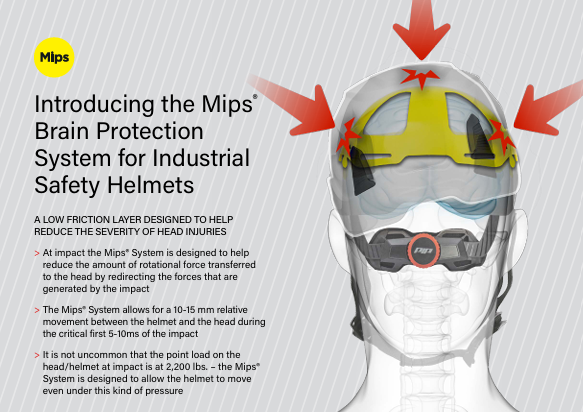 rkplace safety: MIPS® technology.
For nearly 100 years the basic purpose of hard hats has remained the same - to help protect the head against workplace impacts from falling objects from above. Fast forward and today data is telling industry that with nearly 60% of head injuries are caused by fall accidents from higher levels or falls on the same level, it's time to move forward!
THE SCIENCE OF HEAD INJURY
Concussions and Traumatic Brain Injuries are Commonly the Result of Rotational Force and Strain to the Brain.
Injury statistics demonstrate that when someone trips on a level surface, they are more likely to fall at an angle instead of directly on top of the head. This is due to the forward energy of motion that may extend to the head when hitting the hard ground surface. Over the past few years, science has shown that our brains are very sensitive to rotational forces.
WHAT IS MIPS®?
MIPS® stands for Multi-Directional Impact Protection System; a technology originally developed for sports helmets. MIPS® is a safety feature engineered by experts to address a critical gap in head protection: rotational impacts.
While traditional hard hats are effective against direct impacts—like something falling straight onto the head—real-world accidents often happen at an angle. These angled impacts can cause the head to rotate suddenly, transferring dangerous forces to the brain and increasing the risk of concussions or traumatic brain injuries.
MIPS® solves this problem by adding a low friction slip layer inside the hard hat. This layer allows the helmet to shift slightly (10–15 mm) relative to the head during an angled impact, helping to reduce rotational forces and provide an extra layer of safety.
-----------------------------------------------------------------------------------------------------------------------------------------------------------------